Is B.Tech CSE (Data Science with Machine Learning) the Right Choice for Your Career?
2026-10-01

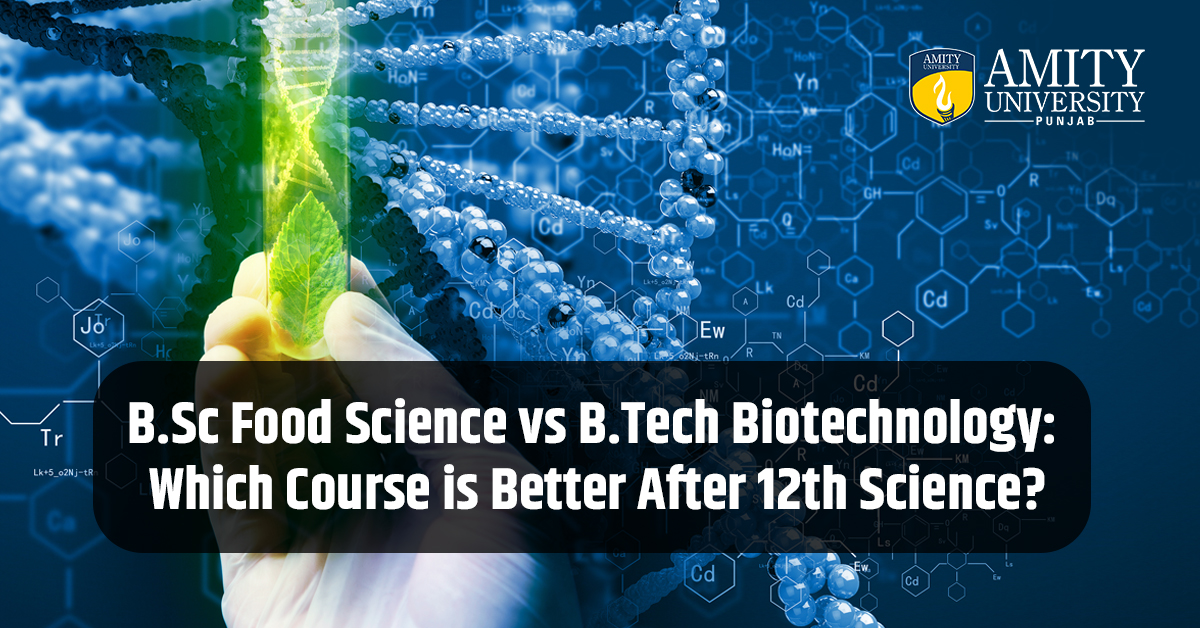
After completing the 12th board exams, students usually get confused about whether to choose B.Sc Food Science or B.Tech Biotechnology. Most students question the scope of these two courses and where this course will lead them five years down the line. Both the B.Sc. Food Technology and B.Tech Biotechnology Engineering deal with science. Both sound impressive enough when someone asks what you're studying. But they're built differently, train you in different ways, and the doors they open aren't the same either. This guide lays out B.Sc. Food Science next to B.Tech. Biotechnology, so the choice comes from what each course actually involves rather than just how the name sounds.
|
Parameter |
B.Sc. Food Science & Technology |
B.Tech. Biotechnology |
|
Duration |
3 years (Honours), extendable to an integrated B.Sc.+M.Sc. of 5 years |
4 years, 8 semesters |
|
Core subjects |
Food chemistry, food microbiology, processing technology, quality control, packaging |
Molecular biology, genetics, bioinformatics, bioprocess engineering, chemical engineering basics |
|
Career scope |
Food manufacturing, quality assurance, product development, food safety regulation |
Pharma R&D, biopharmaceuticals, genetic engineering, bioprocessing, diagnostics |
|
Skills built |
Lab analysis, sensory evaluation, food safety auditing, process optimisation |
Gene editing techniques, PCR, cell culture, bioinformatics tools, plant-scale bioprocessing |
|
Higher studies path |
M.Sc. Food Technology, MBA in food/agribusiness, PG diplomas in food safety |
M.Tech./M.Sc. Biotechnology, MS abroad, MBA, PhD in life sciences |
|
Best suited for |
Students drawn to nutrition, food industry, and applied science with a shorter degree cycle |
Students who enjoy engineering-style problem solving layered onto biology, and don't mind a longer, denser syllabus |
Eligibility rules, course structure, admission routes, all of it varies a fair bit from one college to the next. However, here's the course overview at Amity University Mohali.
● Duration: 3 years (Honours programme), with an integrated B.Sc.+M.Sc. option running 5 years for students who'd rather skip a separate postgraduate application down the road.
● Eligibility: Class 12 pass with Physics, Chemistry, and Mathematics or Biology as compulsory subjects, with a minimum of 55%. (This figure is as per available information at the time of writing; subject-wise cut-offs can be revised, so it's worth confirming on the university's official admission page.)
● Admission: Amity Joint Entrance Examination (Amity JEE), or another entrance score the university accepts, followed by a personal interview, though it's best to verify the exact current process with the admissions office, since entrance requirements for this programme can be revised.
● Duration: 4 years, spread over 8 semesters. The specialisation tracks include pharmaceutical biotechnology, cellular and molecular biotechnology, process technology, food biotechnology, medical biotechnology, and environmental and bio-based technology.
● Note: (These tracks are as listed at the time of writing. Confirm the current specialisation list on Amity Mohali's official biotechnology programme page before applying.)
● Eligibility: Pass class 12 with a minimum of 60% marks aggregate in PCM/PCB, and English should have been a subject at the 10+2 level.
● Entry: Score in the JEE Main test, or take the Amity Joint Entrance Exam, followed by counselling.
Amity Mohali generally requires:
● Marksheets and passing certificates of class 10 and 12.
● Transfer and migration certificates.
● Category certificate, if eligible for reserved category admission
● Scorecard of entrance test (Amity JEE, JEE Main, or CUET, according to the programme you apply for)
● Passport-sized photographs and government-issued ID proof
● Filling out the application form with the relevant fee paid
For both courses, selection is done based on Class 12 percentage as well as entrance test score, followed by an interview round. Candidates scoring 80% or above in Class 12 may also be eligible for the university's direct-admission route, as per Amity's general admission policy. However, confirm for the specific programme at the time of application.
Fee structure for food science and biotechnology degree courses vary depending on university infrastructure, lab work intensity, and accreditation. The following amounts are indicative for Amity University Mohali.
● B.Sc. Food Science and Technology (Honours): The total tuition fee for the 3-year programme is around ₹5.20 lakh, based on the fee ranges available at the time of writing. This can shift with annual revisions, so it's best treated as indicative rather than exact, and confirmed directly with the admission office.
● B.Tech. Biotechnology: Annual fee in first year is around ₹2,21,000. The tuition fee for a 4-year duration ranges from ₹8.5 lakh to ₹9.5 lakh, depending on the annual increase and specialisation-related lab fees. Check the current numbers before applying.
Here are some of the main skills that students will acquire after they complete these courses:
● An ability to analyse food composition data, including protein, carbohydrates, lipids, and micronutrients
● Quality control tests and sensory evaluation tests
● Application of food preservation and packaging methods that increase their shelf life without compromising on their safety
● Identification of food-borne pathogens and their microbiological safety criteria
● Development and formulation of novel food products based on market research and trends
● Exposure to genetic manipulation technologies like CRISPR-Cas9, next-generation sequencing, though how much hands-on work a student gets with each tool can vary by specialisation track and lab access
● Carrying out PCR, ELISA, cell culture, and western blotting in a lab environment
● Design and scale-up of bioprocess systems for the production of fermentation-based or biological products
● Use of bioinformatics tools for analysis of biological data
● A combination of engineering and biology in solution design for production problems
B.Sc. in Food Science include:
● Food quality assurance officer
● Product development associate
● Food safety auditor
● Flavour and sensory analyst
● Plant operations executive
Government positions in food regulatory bodies exist, but most require a separate competitive exam.
B.Tech. in Biotechnology opens up:
● Research assistant and junior research scientist roles across pharma and biotech companies.
● Bioprocess engineering works in manufacturing
● Quality control positions in diagnostic labs
● Entry points into regulatory affairs.
Several of the more senior roles, such as independent research scientist or clinical trial lead, require an M.Sc., M.Tech., or PhD stacked on top of the B.Tech.
What you'll actually earn in either field comes down to the role, the employer, which city you land in, and how much hands-on internship experience you picked up along the way.
Salary surveys across the industry put entry-level pay for food technologists somewhere between ₹3.9 and ₹4.3 LPA, assuming the candidate has some laboratory experience under their belt.
Separately, and going by a different survey methodology, ERI SalaryExpert figures show candidates with 3 to 5 years of experience earning between ₹4.8 and ₹6.2 LPA in some cases.
This doesn't necessarily mean pay drops with experience; it more likely reflects the two sources sampling different roles, cities, or company types, so the numbers shouldn't be read as one consistent progression.
For biotechnology graduates, Internshala's compensation report places entry-level biotechnologist pay around ₹3.9 to ₹4.3 LPA on average, while the salary range for other jobs in biotechnology, including research, quality and process, is somewhere between ₹5.7 and ₹20 LPA depending on specialisation. The salaries for research scientists and bioprocess engineers lie somewhere between ₹4 to ₹8 LPA for freshers and ₹12 to ₹22 LPA with experience, as per the career analysis provided by IILM.
By 2024, India's food processing sector had crossed nearly ₹30.5 lakh crore, close to US$ 354.5 billion, and it's still climbing. Government schemes like the Pradhan Mantri Kisan Sampada Yojana are fueling a good chunk of that momentum, per IBEF's industry figures. The sector currently processes only 12 to 13% of India's total food output. Developed economies do far better on this front, which, per a DD News report on the sector, points to substantial headroom for growth in the years ahead.
On the other hand, biotechnology in India is progressing faster. India's bioeconomy has achieved around US$ 195.3 billion in 2025, with an annual growth rate of 18 per cent, the highest in recent times, and contributes about 5 per cent to national GDP, according to the India BioEconomy Report 2026 released by BIRAC. Policy initiatives backed by the government, such as the BioE3 policy and a ₹1 lakh crore Research, Development and Innovation Fund, are being planned to take India towards achieving a US$ 300 billion bioeconomy by 2030.
Most students who finish a B.Sc. Food Science go on to an M.Sc. in Food Technology or Food Science. Some choose a PG diploma in food safety, and others lean toward an MBA in agribusiness. A PhD usually comes after a postgraduate degree, for those set on a research career.
B.Tech. Biotechnology opens up a wider set of paths. Graduates pursue M.Tech. or M.Sc. in a specialised biotech area, head abroad for an MS, take the MBA route if business or consulting appeals more, or move straight into a PhD programme. Biotech graduates generally find it easier to shift into interdisciplinary postgraduate tracks, such as data science or bioinformatics, than students from a purely scientific background.
● The 40-acre campus sits close to Chandigarh International Airport and houses dedicated food science and biotechnology labs built for hands-on processing, microbiology, and molecular biology work.
● Faculty across both departments combine academic research experience with industry-facing project guidance, so what's taught in class is actually tested against real problems.
● The curriculum follows the National Education Policy (NEP) framework, keeping course content aligned with what's taught at recognised national and international research institutes.
● Internships, industry visits, and applied projects are built into the course itself.
● The university holds NAAC A+ accreditation, along with recognition from UGC, the Department of Science and Technology, and several international academic bodies.
● Specialisation tracks within B.Tech. Biotechnology, like Pharmaceutical, Medical, Food, and Environmental, let students narrow their focus early on instead of waiting until postgraduation to decide.
Whether or not this course is right for you will depend on your interests and preferences. If you get curious about why food goes bad, how packaging manages to keep things fresh, or what "shelf life" on a label really means, then food Science might be of use to you.
But if you are interested in knowing about how genes actually work, how vaccines get developed, or whether lab-grown protein could one day replace regular livestock farming, then you should get into Biotechnology.
There's no wrong answer, and neither path carries more prestige than the other. It all comes down to what type of career you want to pursue and build for yourself.
Amity Mohali's admissions team can walk you through specific specialisation options, lab facilities, and current placement partners for both the B.Sc. Food Science, Technology and Processing programme and the B.Tech. Biotechnology programme. Reach out to our admissions team today!
1. Is B.Sc. Food Science difficult compared to B.Tech. Biotechnology?
None of them is difficult or easy, as it all depends on the student's preference. If the first option focuses more on the applied aspects of chemistry and microbiology within 3 years, then the second includes additional engineering math and process design over 4 years of study.
2. What is the difference in the type of lab work you'll actually do in each programme?
B.Sc. Food Science leans more toward food chemistry, microbiology, and sensory or quality-control labs, while B.Tech. Biotechnology involves molecular biology, genetics, and bioprocess labs alongside more engineering-style coursework. If you enjoy working directly with food products and their shelf life, safety, and quality, Food Science will feel more hands-on in that direction; if genetics and lab-scale bioprocessing interest you more, Biotechnology is the closer fit.
3. Can a student who has graduated from a B.Sc. Food Science pursue a career in biotechnology?
Yes, but it will be a bit complicated, as it can be done via M.Sc. degree in biotechnology-related direction. Catching up on subjects will be required.
4. Which degree provides greater placement opportunities between B.Sc. Food Science and B.Tech. Biotechnology?
Both of them provide good placement pipelines for their industries. Recruiter numbers for each tend to depend on the specific year, role, and industry demand at the time. Pharmaceutical and research-sector hiring, in particular, can vary from one placement season to the next.
5. Is postgraduate qualification obligatory for getting a decent job position after studying B.Sc. Food Science/B.Tech. Biotechnology?
There are enough jobs with entry-level positions for holders of any of these degrees. However, if one needs more complex jobs in the research sector, it may require some additional qualification.