B.A LLB vs BBA LLB: Which to Choose for LLB Admission | Amity Punjab


Choosing a law course after Class 12 feels confusing for many students. Most students know they want to study law, but are not always sure which path suits them better. And during LLB Admission 2026, one question keeps coming up again and again: should you go for BA LLB or BBA LLB?
Both are popular integrated law courses, and both can lead to good legal careers. But the subjects, learning experience and career exposure feel a bit different in each one. So students should understand both properly before making any decision.
The good thing is that there is no wrong choice here. The better option simply depends on your interests, your future goals, and what kind of work you want to do later in the legal field.
|
Factor |
BA LLB |
BBA LLB |
|
Duration |
5 years |
5 years |
|
Core Subjects |
Political Science, History, Sociology, Public Administration + Law |
Management, Finance, Accounting, Marketing + Law |
|
Career Scope |
Litigation, judiciary, civil services, constitutional law, public policy |
Corporate law, company law, business regulations, financial compliance |
|
Best For |
Students interested in humanities, governance, and social issues |
Students interested in business, management, and corporate environments |
|
Higher Studies |
LLM, judiciary prep, civil services, M.A. in Political Science |
LLM, MBA, corporate law specialisations |
Integrated courses allow students to take up studies in law without taking up separate graduation courses first. Both BA LLB and BBA LLB are 5-year courses in which students study law and non-law subjects together.
For example:
BA LLB combines Arts subjects with Law.
BBA LLB combines Business Administration with Law
Both programs are five years long and approved by the Bar Council of India. Students study legal subjects throughout the course, along with their non-law subjects.
This format has become quite popular in recent years because students get more exposure, internships, practical learning and industry understanding from early on.
BA LLB is a 5-year-long program combining both arts and law subjects. The course of study comprises humanities subjects like political science, economics, sociology, history and public administration. In addition, the subjects will also include important legal topics.
A student who enjoys reading, analysis, debates, social issues, public policy or constitutional matters may feel more naturally connected to a BA LLB degree.
Legal subjects generally include:
Constitutional Law
Criminal Law
Civil Procedure
Family Law
Environmental Law
Human Rights Law
Administrative Law
The arts-based subjects give students a broader understanding of society and governance. This becomes useful later in litigation, judiciary preparation, civil services, public policy work and constitutional law careers.
Even though BA LLB and BBA LLB differ in their non-law subjects, the core legal curriculum overlaps quite a bit between the two. Both sets of students end up studying:
Constitutional Law
Criminal Law
Law of Contracts
Civil Procedure Code
Law of Torts
Family Law
Jurisprudence
Property Law
Evidence Law
So the legal foundation students receive is largely the same regardless of which programme they pick. What actually changes is the second half of their coursework, arts-based subjects in one case, business-based subjects in the other. This is worth keeping in mind since a lot of the confusion around "which is better" comes from assuming the law content itself differs, when it mostly doesn't.
BBA LLB is also a five-year integrated law program, but the combination here is different.
Instead of arts subjects, students here study business and management-related subjects along with law. Topics may include management principles, finance, accounting, marketing, business communication and organisational behaviour.
At the same time, core legal subjects continue throughout the program.
This course is mostly preferred by students who are interested in things like:
Corporate law
Company law
Business regulations
Mergers and acquisitions
Financial compliance
Corporate consulting
A student who enjoys business discussions, startups, management topics or commercial environments may feel more aligned with BBA LLB, honestly.
Many students think one course is better than another when they compare BA LLB vs BBA LLB. But actually, the difference is more about academic focus than about quality.
BA LLB focuses more on humanities, governance, society and public systems. BBA LLB focuses more on management, business operations and corporate environments.
The law subjects remain mostly similar in both programs. Students in both courses study important legal areas and can become lawyers after completing their graduation.
The difference mainly comes from the extra subjects included in the course structure.
Here is a simple way to understand:
|
Arts + Law |
Business + Law |
|
More focus on social sciences |
More focus on management |
|
Useful for litigation, judiciary, civil services |
Useful for corporate legal careers |
|
Covers political and social systems |
Covers business and corporate systems |
Still, career paths are not fully fixed. A BA LLB graduate can also enter corporate law, and a BBA LLB graduate can also become a litigator.
This is probably the biggest doubt students have during LLB Admission 2026.
Reality is that both courses offer strong opportunities if the student builds the right skills during college years. Law today is not limited to courtroom practice only. Graduates now work in many different places, such as:
Corporate law firms
Legal consulting companies
Courts and litigation chambers
Startups
Policy organisations
NGOs
Government departments
Legal process outsourcing firms
Academic and research institutions
Students from the BA LLB sometimes develop stronger analytical and socio-legal understanding because of their humanities background. Meanwhile, students from BBA LLB may develop better familiarity with corporate systems and business structures.
But internships, communication skills, research ability and practical exposure honestly matter more than the course title itself most of the time.
Students stress too much trying to predict their entire future before even entering college. That mostly creates more confusion than clarity. Instead of overthinking, just ask yourself a few simple questions.
Choose BA LLB if:
You love subjects like political science, history, sociology and public affairs.
You are planning to take a career in the judiciary or civil services.
You like reading books and analysing texts.
You are interested in studying Constitutional law or criminal law.
You like discussions on social issues.
Choose BBA LLB if:
You enjoy business topics and management concepts.
You are curious about companies and corporate systems.
You are interested in commercial law.
You may want to work in a corporate firm later.
You prefer practical, business-oriented learning.
Sometimes, students also consider choosing the courses according to their personality. If you find yourself comfortable in a business environment, you can opt for BBA LLB. Otherwise, go for BA LLB.
Admission Process
The admission procedure for integrated law programmes varies from university to university, but generally follows this pattern:
Filling out the online application form
Checking and meeting the eligibility criteria
Appearing for an entrance examination, where required
Attending a personal interview or counselling session, if shortlisted
Confirming admission through fee payment
Some universities rely on national or state-level law entrance exams, while others admit students directly based on Class XII marks. It's worth checking each university's specific process since this differs quite significantly across institutions.
Documents Required
Students should have the following ready before starting the application process:
Class X and XII mark sheets and certificates
Transfer certificate from the previous institution
Migration certificate, if applicable
Passport-size photographs
Valid government ID (Aadhar card or equivalent)
Entrance exam scorecard, if applicable
Category certificate, for reserved category applicants
Admission Tips
Start checking university websites and application deadlines well before Class XII results are announced, since some entrance exams follow an earlier schedule
Keep both physical and scanned copies of all documents ready in advance
Research the entrance exam pattern early if the target university requires one, rather than waiting until the last month
Compare eligibility criteria across a few universities rather than relying on just one, since minimum percentage requirements can shift slightly year to year
The eligibility criteria varies from college to college. At Amity University Punjab, the eligibility criteria for both B.A. LL.B. (Hons.) and BBA LL.B. (Hons.) are:
10+2 with a minimum 50% marks.
However, it's always better to check the latest admission policy of the university before applying. The LLB eligibility criteria may vary slightly according to each university.
Sometimes students become too focused on which course is "better." But honestly, legal careers depend heavily on personal skills also.
A strong law student usually develops:
Communication ability
Research skills
Confidence during arguments
Legal writing skills
Critical thinking
Problem-solving ability
Professional ethics
These skills can be developed in both BA LLB and BBA LLB. The college environment, faculty support, internship exposure, moot court activities and practical learning opportunities often shape a student much more than just the course title alone.
Graduates from either programme have several paths open for further studies, depending on where they want to take their legal career.
Common Postgraduate Options
LLM (Master of Laws), useful for students wanting deeper specialisation in a specific area of law, whether constitutional, corporate, criminal, or international
Judiciary Services preparation, for students aiming to become judges or magistrates, typically more common among BA LLB graduates given the overlap with constitutional and public law subjects
Civil Services preparation, since the humanities background from BA LLB often supports the UPSC or state civil service exam pattern well
MBA, particularly relevant for BBA LLB graduates who want to move into legal consulting, compliance, or management roles within corporations
Specialised certifications, in areas like intellectual property law, taxation law, or cyber law, open to graduates from either programme
None of these paths are locked to one degree over the other. A BBA LLB graduate can still sit for judiciary exams, and a BA LLB graduate can still pursue an MBA. The degree shapes the foundation, but postgraduate choices remain flexible based on where the student's interest goes after graduation.
Future scope after both programs remains quite strong because legal knowledge is now needed in many different industries.
Graduates may choose higher studies like:
Some students move into litigation while others join law firms or corporate legal departments. Both directions have good opportunities available currently.
The flexibility is one of the biggest strengths of integrated law courses. Students are not restricted to one narrow career path after completing graduation.
The Department of Law at Amity University Punjab covers both theoretical understanding and practical legal training. Students study major legal disciplines like constitutional law, criminal law, and civil procedure, while also working on advocacy and legal research skills through the course.
Students don't just study core legal subjects, they also get involved in advocacy training, legal research, and analytical skill-building as part of the coursework. This is meant to give students an understanding of how law functions in practice, not only in theory.
Law programmes at Amity Law School are approved by the Bar Council of India, which matters for students planning a formal legal career. The curriculum follows recognised legal education standards and prepares students for a range of legal career paths after graduation.
Students can choose specialisations in the final years of the programme, including International Law, Constitutional Law, Corporate Law, and Criminal Law, depending on their interests and career direction.
The programme includes moot courts, legal discussions, research activities, and case-based learning. These are meant to help students build practical understanding alongside classroom learning.
Faculty members guide students in both academic and professional aspects of law. The department also places emphasis on ethics, critical thinking, and overall skill development, areas that matter for long-term legal careers.
The university's placement cell supports students with internships, interview preparation, and campus placement opportunities, helping them transition into law firms, corporate legal departments, and consultancies after graduation.
Choosing between BA LLB and BBA LLB comes down to academic interest in more than one course being objectively better than the other. BA LLB suits students drawn to humanities, governance, and litigation-focused careers, while BBA LLB suits those interested in business structures and corporate legal work.
Both degrees share the same core legal subjects and lead to the same range of professional licensing, the real difference lies in the additional coursework and the direction it tends to push students toward. Career outcomes in both cases depend more on internships, research experience, and practical skill-building during the five years than on the degree title itself.
Students considering LLB Admission 2026 should weigh their own interests against the subject structure of each programme before deciding, since both paths lead to legitimate, recognised legal careers.
Amity University Punjab is one of the best law colleges in Punjab for pursuing law-related courses. Visit our website to know more about the admission process and apply for a law program now!
Both courses are good career options. BA LLB is more suitable for students interested in social sciences and litigation, while BBA LLB is often preferred by students interested in corporate law and business environments.
Both BA LLB and BBA LLB are integrated law courses with a duration of 5 years.
For integrated law programs like BA LLB and BBA LLB, students usually need to complete 10+2 with the minimum marks required by the university.
Some universities require entrance exams, while others may offer admission based on academic performance and university admission criteria.
Yes, students from both courses can build careers in corporate law firms if they develop strong legal knowledge, internship experience, and professional skills.


Many students who enjoy reading books, poems, or even movies and storytelling often think about choosing literature after Class 12. But at the same time, there is also confusion. Students and parents both ask one common question: What will you do after BA English?
Some people still think that a graduation in English literature only leads to teaching jobs. But this is not true anymore. Today, companies need people who can write clearly, explain ideas properly, understand audiences, and communicate professionally. Because of this, the scope of the English language and literature has expanded a lot in recent years.
Students exploring BA English career options usually want to understand whether the course will actually help them build a stable career. They want to know what kind of jobs are possible, what skills they will learn, and what higher studies they can choose later.
However, if you're the type of student who enjoys reading, writing, analysing ideas, or expressing thoughts clearly, then a BA in English literature is one of the best degrees for you. This guide will help you understand the BA English literature syllabus, career scope, higher study options, and whether this degree is the right choice for you.
Many students choose science or commerce because they think those streams have more job options. But not every student enjoys numbers or technical subjects. Some students feel more comfortable expressing ideas through writing or discussion.
Graduating in English language and literature lets students study various topics related to storytelling, cultures, communication, human psychology, etc. Moreover, literature helps students understand different perspectives and improves their thinking ability.
Studying novels, poems, dramas, and essays sharpens the minds of students and influences how people think, how society changes, and how communication shapes the world.
One of the main highlights of BA English literature is skill development. The course does not only focus on reading texts. It also helps students improve their thinking and communication abilities.
Students learn how to express ideas clearly in written and spoken form. Writing essays and analysing texts improves vocabulary and sentence structure.
Strong communication skills help in careers such as media, marketing, teaching, and public relations.
Literature makes students develop the habit of analysing various factors. The student learns to analyse rather than accept information as it is. This skill is beneficial when researching and making decisions.
Students develop creativity while writing essays, stories, and assignments. Creative thinking helps in storytelling, branding, and content creation. Creative expression is useful for a career in content writing and communication roles.
Students learn how to collect information and present arguments logically. Research skills are useful for academic careers and professional writing roles. These skills expand the range of BA English career options available after graduation.
Here are some of the main subjects covered in English language and literature:
Poetry and Drama: Students read poetry and plays from different periods. Understanding literary style helps improve interpretation ability.
Fiction and Novels: Students analyse novels written by authors from different cultures. Literature helps students understand social themes and human emotions.
Linguistics: Students study how language works and how communication develops.
Creative Writing: Students learn how to write essays and express ideas creatively.
Cultural Studies: Students explore literature in relation to society, history, and culture. The course helps students develop a deeper understanding of language and storytelling.
Faculty members guide students to interpret texts and understand the social and cultural contexts of literature.
Students interested in graduating in English literature can choose between two course structures.
BA English Honours
Duration: 3 years
BA English Honours with Research
Duration: 4 years
Eligibility Criteria
Minimum 70% marks in English in Class 12.
Students who enjoy reading and writing usually feel comfortable in this course. The program encourages interpretation and critical understanding of literary traditions.
One of the biggest concerns students have is job opportunities. However, BA English career options are quite diverse. The skills that you learn during English language and literature programs are useful in many industries. Here are some of the most common career paths.
One of the most popular careers for BA English graduates is content writing. Companies hire professional writers to produce texts for websites, blogs, campaigns, and social media. Content writers prepare informative articles and pages on company websites. There are freelance opportunities for such writers. Students who love writing always explore this career opportunity.
Students often go for teaching after doing an MA in English literature and getting trained through the B.Ed program. English teachers can teach in schools, colleges, and special language institutes. Students who love explaining new ideas tend to choose such a profession.
Companies that publish content hire editors who check documents and eliminate errors. Such professionals help make texts understandable and grammatically correct. Those who love to deal with books often pursue such careers. Plus, editing roles are available with many digital marketing organisations.
Media houses require experts in clear and logical writing. Journalism involves writing news articles, scripts, and reports. Hence, students with good writing skills often get into this field. Understanding the perspective of the audience helps to become a successful journalist.
Companies employ professionals who facilitate interactions with consumers and employees. Since public relations specialists write press releases, they need good communication skills that a BA in English teaches them.
The digital marketing and social media field requires developing a digital communication strategy. Creating texts for brands, stories, and promotions requires good writing skills. Students who love creative communications often consider this field. Knowledge of audience behaviour is useful for such a BA English career.
A lot of students pursue further studies after completing a BA in English literature to specialise in specific areas. So, here are some of the most common higher studies programs:
In MA English Literature, students get to study literature and its research methods in depth. It is suitable for academic careers.
Students can also pursue media careers if they've completed journalism/mass communication courses.
Some students also pursue an MBA after completing their studies in English literature. MBA course teaches them management and lets them explore careers in marketing and business communication.
Those who want to explore careers in storytelling may go for creative writing courses.
The approximate fee structure for BA English program is:
|
Course |
First Year Fees |
Total Course Fees (Approx) |
|
BA (Hons) English |
₹1,00,000 |
₹2.4 lakh approx |
|
BA English Honours with Research |
₹1,00,000 |
₹3.2 lakh approx |
A BA (Hons) in English can lead to well-paying career paths, especially as you gain experience or specialize. While entry-level salaries are usually modest, professionals who move into high-demand roles can earn ₹10 LPA or more.
Freelancing and international remote roles can push earnings even higher, particularly in writing, editing, and marketing. Upskilling in areas like SEO, UX writing, or technical documentation can significantly boost salary potential.
Here are some reasons why students consider Amity University Mohali for BA English Literature:
At Amity, students are exposed to literature from different countries and eras. By analysing texts in various literary traditions, they understand the evolution of language and expression. After studying ancient and modern literature side by side, students begin to see changes in themes of identity, societal issues, relationships, and culture.
It provides a broad perspective and allows the students to make a careful analysis of various texts. Knowledge of diverse literary traditions enables them to relate literature to real-world situations.
With time, they become adept at reading complicated texts and understanding the hidden meanings of stories.
One of the main benefits of pursuing a BA in English from Amity Mohali is that our department builds your communication skills from the ground up. Students are asked to write essays, assignments and critical analyses in the subject.
Regular writing practice makes students more confident and lets them write clearly. They learn how to structure ideas logically and put them into words.
These are very valuable skills for a wide range of professions, including media, marketing, teaching and publishing. For example, those planning a career in content writing gain a lot from consistent writing practice in the course.
Moreover, Amity pushes students to participate in discussions and presentations in class and through the interpretation of different texts and develop communication skills. Such skills are important in professions where clarity in communication matters a lot.
Studying literature trains students to think beyond the literal meanings of texts. They learn to conduct character analysis and identify themes and ideas across texts.
During the reading of literary pieces, they discuss many questions related to society, culture, and human behaviour. The process gives them a perspective on the existence of various viewpoints and varying interpretations.
Moreover, Amity Mohali's BA English course curriculum helps students make sound judgments based on careful evaluation of information. The course curriculum makes students more precise by making them analyse different texts.
Such qualities are not only helpful in educational pursuits but also in professional careers requiring analysis.
Some students opt to go for higher education in future. For these students, research-oriented learning is very beneficial. In Amity, students receive training in thoroughly studying texts and conducting literary research.
Moreover, they get expert guidance from experienced faculty members on understanding literary theories, research methodologies, and analytical methods.
Developing research skills prepares students for postgraduation in MA English or other specialised disciplines. Plus, they learn to prepare assignments logically and construct arguments. Students gradually get the idea of how to present their views supported by evidence from texts and gain confidence naturally.
Pursuing a BA in English Literature equips you with the skills to pursue multiple professions. You learn a lot of skills during the course and are not confined to one particular profession.
You have plenty of career opportunities in writing, editing, teaching, media and communication. Moreover, the course teaches transferable skills such as interpretation, communication, and creativity, and helps students enter any industry and get high-paying jobs.
This aspect of the program is valuable for students who look forward to multiple career paths rather than a single one.
Whether or not you should choose to do a BA in English literature depends on your personal interests. You should opt for a BA in English Literature if:
You enjoy reading and writing.
You have a keen interest in language and literature.
You want to build speaking and writing skills that help you in the real world.
You like analysing ideas and concepts.
The scope of BA English career options has widened in recent years. The course teaches you reading, writing, comprehension, problem-solving, and top-notch communication skills. Those who complete graduation in English literature can pursue careers in writing, teaching, media, marketing, communications and many other professions.
The program helps students develop logical thinking and observation skills. If you're looking for the best college for BA English Literature, then consider enrolling in Amity Mohali.
Students can work in writing, teaching, media, publishing, and communication roles.
The syllabus includes poetry, novels, linguistics, and cultural studies.
Yes, students can explore careers in education, content writing, media, and corporate communication.
Yes, students usually complete an MA and a B.Ed before teaching.
Yes, strong writing ability helps students work in digital content and marketing roles.

Engineering is one of the most sought-after professions after Class 12th in India. To become an engineer, you need to pursue a B.Tech. Most students in India choose to pursue B.Tech due to a high salary, strong demand, and future job stability. However, traditional engineering specialisations and disciplines have become redundant and don't offer much growth and potential when it comes to jobs. Nowadays, technology is developing very fast, and companies are using data for all their decisions.
Hence, data science engineering is becoming one of the most sought-after career options after Class 12. This field is focused on making data-driven decisions using various methods of reasoning. If you love analysing things and solving practical issues, and have a keen interest in technology, then a B.Tech in data science could be your ideal choice.
In this guide, you will learn about data science course details, eligibility criteria, syllabus, course fees, salary, career opportunities, and future scope in detail. Moreover, here we will talk about why Amity Mohali is one of the best choices among colleges for engineering in Punjab.
A B.Tech in Data Science is a four-year computer science engineering (CSE) degree where students learn about data management, processing, and analytics.
Every day, millions of data points are generated. Let's understand the same through examples:
E-commerce websites track customers' behaviour
Hospitals keep track of patient records
Banks keep checking fraudulent transactions
Mobile apps record users' behaviour on the app platform
Such insights are provided by data scientists to organisations to help them make decisions.
Some universities provide B.Tech. CSE Data Science specialisation, where the student learns core computer science subjects and the latest technologies like Artificial Intelligence (AI), Machine Learning (ML), etc.
The demand for skilled data professionals is constantly increasing every year. In the modern business era, companies need quick and efficient decision-making. This is where data professionals can help:
Better customer understanding
Future predictions
Minimised risk factor
Improved offerings
Higher profitability
The future of data science is promising as almost every organisation is making use of data science techniques. Be it the healthcare industry, banking sector, marketing field, sports, e-commerce, manufacturing, government organisations, or educational institutions, all require data science professionals. If you build enough skills, then you can land a premium, high-paying job in a top company.
Before you can apply for B.Tech data science, you should know about the eligibility criteria. Here's the general eligibility criteria for pursuing B.Tech in Data Science
|
Requirement |
Details |
|
Qualification |
Class 12th from recognized board |
|
Subjects |
Physics, Mathematics, Chemistry / Computer Science / IT |
|
Minimum Marks |
60% aggregate |
|
Duration |
4 years |
Eligibility Criteria at Amity Mohali:
Minimum 60% marks in class 10 & 12 with Physics + Mathematics + Computer Science/ IT/Informatics Practices/Electronics
Learning about the B.Tech data science course details can help you understand what you'll study in 4 years. You'll mostly focus on theory and hands-on practical experience and work on real-world case studies, projects, and real-world datasets.
Core Subject Areas Covered in the Program
Basics of programming (Python and R)
Mathematics for computing
Basics of statistics
Probability
Data Visualisation
Machine learning algorithms
Big data techniques
Database management system
The syllabus for B.Tech. Data Science has been carefully drafted by universities keeping in view the growing demands of the industry.
1st Year – Basics and Foundations
Basics of computer science
Engineering mathematics
Programming languages
Basics of networking
Basics of communication
Students learn about the basics of computer science.
2nd Year – Advanced CSE Subjects
Computer architecture
Basics of databases
Data structures
Operating system concepts
Students learn about storing data.
3rd Year – Specialised Data Science Topics
Basics of machine learning
Big data analytics
Data Mining
Data visualisations techniques
Artificial intelligence
Data Scientists start working on real datasets and projects.
4th Year – Deep Learning Techniques and Applications
Advanced machine learning algorithms
Deep learning techniques
Research and Industry Project
Capstone project
To excel in this particular branch, some specific skills are necessary.
Technical Skills for Data Scientists
Basics of programming
Basics of database
Statistical concepts
Machine learning algorithms
Data visualisation techniques
Soft Skills for Students of Data Science
Logical thinking skills
Strong analytical ability
Problem-solving skills
Effective communication
Interest in learning new technology
Fees are one of the most important considerations for students when it comes to choosing a course or college. Here's the fee structure for B.Tech Data Science at Amity Mohali:
|
Year |
Fees |
|
First Year |
₹2,13,000 |
|
Duration |
4 years |
B.Tech Data Science salary is very impressive in India. You can work in a lot of tech companies and can command a high salary. However, there are a lot of factors that affect the salary, like skills, college reputation, internships, and experience. The average salary for B.Tech Data Science in India is between Rs. 10 lakhs to Rs 30 lakhs per annum.
Skilled students from good B.Tech data science colleges like Amity Mohali have a higher chance of getting placements.
Career Options for Data Science Graduates
Data science engineers have vast job opportunities across industries.
Popular Careers for Data Science Engineers
Data scientist
Data analyst
Machine learning engineer
AI engineer
BI Analyst
Data engineer
Research analyst
Product Analyst
Types of Companies That Hire Data Scientists
IT companies
Financial sector
Healthcare companies
E-commerce firms
Consultancy firms
Government organisations
Startups
The career scope after completion of the data science course is promising.
A B.Tech CSE in Data Science is very different from traditional CSE engineering courses. Here's a comparison:
|
Feature |
Traditional CSE |
Data Science Engineering |
|
Focus |
Programming |
Data + Programming |
|
Demand |
High |
Very High |
|
Salary Growth |
Good |
Very Good |
|
Career Roles |
Developer |
Analyst + Scientist |
|
Future Scope |
Stable |
Rapid Growth |
Students interested in data, AI, ML and other similar topics go for a B.Tech CSE specialisation in data science.
When you are deciding on an engineering college in Punjab, you must never think in terms of academic criteria. Rather, you should keep yourself focused on exposure, learning and industry readiness. Amity Mohali happens to be amongst the best engineering colleges in Punjab and provides its students with the right exposure to sound theoretical knowledge and practice. Here are some reasons why you should choose Amity Mohali for B.Tech. Data Science:
Amity Mohali has designed the B.Tech data science program according to industry demands and current technology. The main subjects include programming, statistics, data analytics, machine learning, and artificial intelligence. The curriculum keeps getting updated to meet the ever-changing demands of IT companies. This way, Amity Mohali ensures that its students remain industry-ready for the future.
Amity Mohali ensures that students become proficient in data science by implementing what they learn in class. There are lots of practical and project-based exercises in the course curriculum that teach students how to apply data science principles in solving real-world business problems. This further enhances their technical knowledge.
The data science course offered by Amity Mohali covers computer science, mathematics, statistics, and business aspects. Students enrolled in this course learn a lot more beyond programming. The approach ensures that the future graduates possess all the skills required for data science.
All faculty members have solid academic qualifications and practical industry experience. They adopt an interactive approach in their teaching methodology. Students receive support in learning and conducting projects.
A conducive learning environment plays an important role in offering technical education. Students can avail themselves of modern computer lab facilities equipped with state-of-the-art software. With Amity's vast and detailed learning resources, students learn programming languages and advanced concepts related to machine learning and data science.
Apart from technical subjects, students learn communication skills, presentation skills, and other critical skills that play an important role in the IT world. These skills help them in interviews and the workplace.
With this course, students learn how data science helps in improving business operations. They can analyse data and make informed decisions based on it. The approach makes the students suitable for various job roles in IT companies.
After completing the course successfully, students acquire skills of using mathematics, programming and data analysis techniques in solving real-life problems. They are knowledgeable about the concepts of network security, information security and computing systems. After completing this course, students become ready for the global IT industry.
There is a rising demand for data science professionals across organisations. This makes it easy for students to find lucrative career prospects after graduating from this course.
Engineering in Punjab requires students to opt for a university offering advanced courses along with practical exposure. Amity Mohali has everything that can make students successful engineers in the coming years.
Career Opportunities in the Data Science Field
Technology is progressing very rapidly, and the demand for data science is not slowing down. Here are some of the career opportunities in data science:
Artificial Intelligence
Machine Learning
Big Data Analytics
Robotics
Automation
Business Intelligence
Predictive Analytics
Students can join Amity Mohali through its admission process.
Admission Process Steps
Eligibility check
Application form submission
Submissions of documents
Completion of admission formalities
Payment of fees
Confirmation of the seat
Choosing the right career path is a crucial decision. B.Tech in Data Science is among the best courses for students looking to build a career in the technology and analytics sector. The course provides a solid base of technical knowledge as well as practical exposure to the students. Students can learn how to solve real-world business issues using data. Due to the rising demand for data professionals, this course is promising in terms of career development and salary. If you're looking for the top college for pursuing B.Tech in data science, then enroll in Amity Mohali today!
1. What is the duration of B.Tech Data Science course?
The duration of B.Tech in data science is 4 years.
2. What are the subjects in B.Tech Data Science syllabus?
The B.Tech data science syllabus includes programming, statistics, machine learning, database management, and artificial intelligence basics.
3. What is the average B.Tech Data Science salary?
The average B.Tech data science salary for freshers ranges between ₹4 LPA to ₹12 LPA, depending on skills and job role.
4. What are the eligibility criteria for B.Tech Data Science?
Students must complete Class 12 with Physics and Mathematics with a minimum required mark as per university guidelines.
5. What skills are required for a data science career?
Important skills for data science include programming, analytical thinking, statistics understanding, and problem-solving ability.
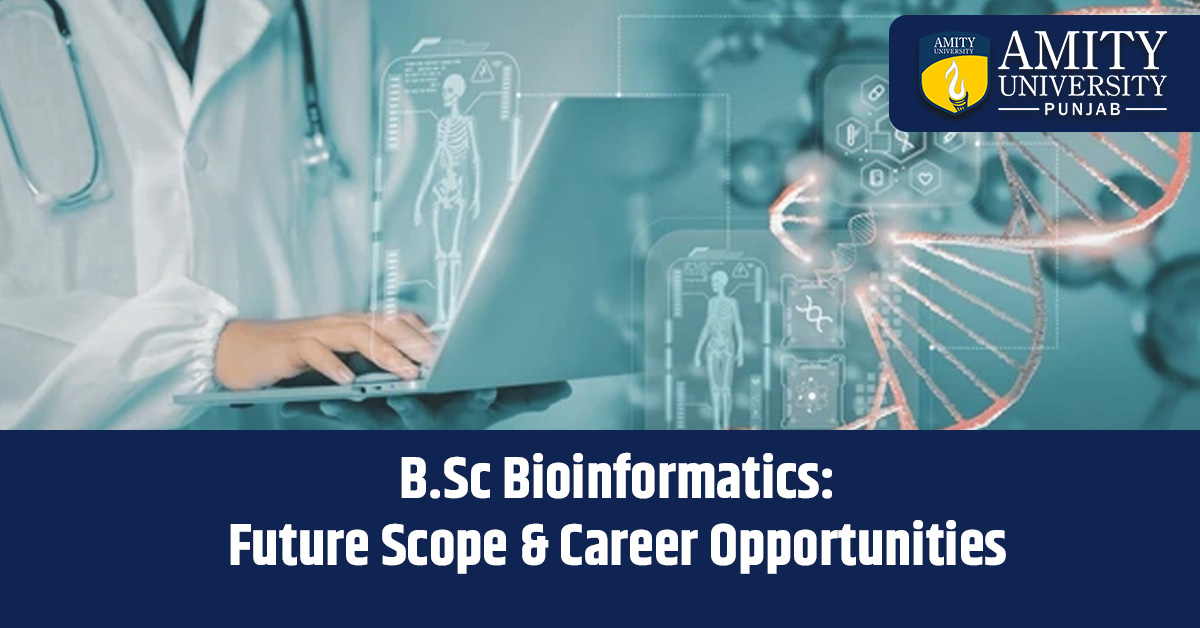
Many students who take science in Class 11 and 12 mostly think about careers like MBBS, Biotechnology, Pharmacy or Microbiology. But now some new fields are also coming, which mix biology with technology. One such field is Bioinformatics. This field is getting popular because today research not only happens in a lab, but also happens through computers and data analysis.
Students who like both biology and technology often feel confused about which course they should select. Some students enjoy the biology subject but also have an interest in computers. For such students, B.Sc Bioinformatics can be a good option. This course helps students understand biological data with the help of computer tools, so it becomes a little different from normal life science courses.
The bioinformatics course scope is increasing because many industries now depend on data-based research in healthcare, medicine, genetics and drug development. Many discoveries today happen through data analysis and not only through lab experiments. Because of this reason, many students are searching for a B.Sc. Bioinformatics colleges in Punjab and other cities, so they can understand future career options better.
In this blog, we will understand course structure, career scope, salary expectations, higher study options and also see how this field compares with biotechnology.
B.Sc Bioinformatics is a course where biology meets computer science and mathematics. In this field, scientists use computers to study DNA, genes, proteins and diseases. They do not depend only on lab experiments. They also use software tools to check and analyse biological data.
The Department of Bioinformatics mainly works on creating computer-based methods that help people understand biological systems better. Researchers use these methods to improve medical research and find solutions for many health problems.
Students who choose B.Sc. Bioinformatics involves learning how to handle complex biological data using programming and statistics. They use tools and software to study patterns inside genes and cells. Because of this reason, many students who like research fields choose this course.
Bioinformatics helps scientists find disease patterns, create new medicines and understand genetic problems. The need for bioinformatics experts keeps increasing because the healthcare industry keeps growing and changing.
Healthcare and biotechnology industries are growing very fast due to new diseases, advanced medicines and personalised treatments. Bioinformatics helps researchers handle very large biological data quickly and more efficiently.
For example, genome sequencing creates a huge amount of data. Researchers must analyse this data with computer tools. Without bioinformatics, scientists may take many years to understand such complex information.
The bioinformatics course scope keeps increasing because industries want professionals who understand both biology and data analysis. Pharmaceutical companies, research labs and healthcare organisations need experts who can understand biological data properly.
Students who like research, healthcare innovation and technology usually see this field as a modern career option with good future scope.
Students who want to study B.Sc. Bioinformatics applicants should know about the duration and eligibility before applying for admission.
B.Sc (Hons) Bioinformatics normally takes 3 years to complete. Some universities also provide a 4-year Honours with Research option for students who want deeper research exposure.
Some institutes also provide integrated courses which combine undergraduate and postgraduate degrees.
Students usually need at least 60% marks in Class 12 with science subjects like Physics, Chemistry, Biology or Mathematics.
Students who show interest in biology and basic computer knowledge usually find this course easier to understand. The curriculum follows NEP 2020 guidelines, so students can continue higher studies in India or even abroad.
Many students want to know which subjects they will study in this course. The curriculum mixes biology subjects with programming and data analysis topics. Students learn how biological data is produced and how computer tools help analyse that data.
Here are the core subjects in Bioinformatics:
Students learn about genes, DNA structure and molecular activities inside cells. Genetics helps students understand how traits pass from one generation to another.
This subject helps students build a strong career in genomics and biomedical research because many diseases are connected with genetic changes.
Biochemistry explains chemical reactions happening inside the human body. Students learn how proteins and enzymes work in different biological processes.
Knowledge of biochemistry helps students understand disease development and the process of creating medicine.
Students learn programming languages like Python, R and C++. Programming helps students analyse large biological datasets faster.
Programming skills play a very important role because bioinformatics depends strongly on computational tools.
Students study genomics, proteomics and transcriptomics under omics studies. These subjects help students understand biological systems at the molecular level in a better way. Students learn how genes, proteins and RNA work together inside living organisms. Researchers use omics studies a lot in drug discovery and also in personalised treatment methods because they give a deeper biological understanding.
Students learn how different software tools help scientists design new medicines and also study chemical structures in detail. Molecular modelling helps researchers predict how molecules behave and interact with each other. Drug design shows one very important use of bioinformatics in the pharmaceutical industry because companies use this method to create better and more effective medicines.
Artificial intelligence helps researchers analyse biological data in a faster and more accurate way. Machine learning methods help scientists find hidden patterns in large genetic datasets, which are not easy to detect manually. AI is becoming more important in biological research because the size of biological data is continuously increasing day by day, and researchers need smart tools to manage it.
Students usually compare biotech vs bioinformatics before selecting the course. Both fields come under life sciences, but both follow different ways and approaches.
Biotechnology mostly includes lab experiments and the study of biological processes. Bioinformatics mainly deals with analysing biological data with the help of computer tools and software.
|
Factor |
Biotechnology |
Bioinformatics |
|
Work environment |
Laboratory |
Computer-based research |
|
Focus area |
Biological experiments |
Data analysis |
|
Skills required |
Biology knowledge |
Biology + programming |
|
Industry demand |
Pharmaceutical labs |
Research & data-driven healthcare |
Students who like practical lab work usually go for biotechnology. Students who feel comfortable with computers and data usually prefer bioinformatics.
Personal interest plays a very important role. When students understand what they enjoy more, they choose a better career path and feel more confident about their future.
Students who complete B.Sc Bioinformatics gains a mix of technical and analytical skills. These skills help them work in the research field and technology-based industries. The course prepares students for real-world scientific problems.
Students learn programming languages that help them analyse biological datasets properly. Knowledge of algorithms helps students handle complex information in an easier way.
Students understand biological data, and they learn how to read genetic information correctly. They also learn different software tools that researchers use in labs and research organisations.
Students improve computer handling skills and become comfortable with databases, sequence analysis tools and bioinformatics platforms.
Students learn how to interpret scientific results, and they identify useful patterns from biological data. Research assignments improve problem-solving ability step by step.
Students develop critical thinking, which helps them in scientific research and innovation. They understand how to connect biology concepts with computational methods.
Students exploring bioinformatics jobs Punjab often want to know whether there are opportunities locally. Bioinformatics professionals are employed in pharmaceutical companies, healthcare research labs, and biotechnology organisations.
Common job roles include:
Bioinformatics Analyst
Computational Biologist
Genomics Researcher
Research Associate
Biostatistician
Software Programmer
These professionals work on analysing biological datasets and supporting research projects.
Industries such as healthcare, agriculture biotechnology, pharmaceutical companies, and research organisations employ bioinformatics graduates.
The bioinformatics salary is considered strong for a specialised science and technology field. Entry-level professionals such as Bioinformatics Analysts or Research Associates can expect starting salaries of around ₹10 lakhs per annum or more, depending on their programming skills, research exposure, and knowledge of genomics tools.
Students usually compare course fees before choosing a college. Understanding fees helps students plan education expenses properly.
Approximate first-year fee structure:
|
Course |
First Year Fees |
|
B.Sc Bioinformatics |
₹1,30,000 |
|
B.Sc Bioinformatics Honours with Research |
₹1,30,000 |
Below are some important reasons why students consider Amity Mohali while evaluating the bioinformatics course scope.
One strong advantage of studying B.Sc. Bioinformatics at Amity Mohali is the interdisciplinary curriculum. Students do not study biology in isolation. Instead, they learn how biological problems are solved using computational tools and programming languages.
Subjects such as genetics, molecular biology, and biochemistry are combined with Linux-based programming, data analysis, and modelling techniques. This helps students understand how biological data is processed and interpreted in real-world research environments.
Because bioinformatics requires both biological understanding and technical skills, learning both areas together helps students build a stronger academic foundation.
The curriculum focuses on areas such as genomics, proteomics, systems biology, and biological data modelling, which are widely used in research and pharmaceutical industries.
Bioinformatics is growing very fast now because today, biological research does not work alone; it also depends on AI and data science tools. Amity Mohali make students learn about AI and machine learning in bioinformatics, so they slowly understand how technology is helping in improving biological research work.
Students also study how machine learning helps in finding patterns inside genetic datasets and is also useful in the personalised medicine area. This type of exposure makes students more updated with the latest research trends going on in the bioinformatics field.
When students understand artificial intelligence use in biology, it gives them an extra benefit when they plan their future in research or technology-based careers. Learning these tools from an early stage makes students more comfortable when they handle complex datasets, which usually look confusing at first.
The curriculum is made according to NEP 2020 guidelines, which mainly focus on flexibility, research knowledge, and skill improvement. Because of this, students get knowledge that is not only useful in India but also helpful at a global level.
Students who want to go abroad for higher studies also get an advantage because the curriculum structure is similar to international academic standards. The program also matches global education needs, so students do not face many problems while applying for postgraduate courses in foreign universities.
When the curriculum is globally relevant, students adjust easily in different academic environments and research cultures without much difficulty.
Amity Mohali focus on helping students build skills that industries actually need in the present time.
Students learn programming languages, data understanding methods, and biological modelling tools that are commonly used in the research field. These skills help students know how biological data helps in making medicines and healthcare solutions better.
When students learn industry-related skills, they can explore bioinformatics jobs in Punjab and also check opportunities in research organisations in India and outside India. After completing a degree, graduates can work in pharma companies, biotechnology firms, healthcare analytics companies, and academic research institutes.
Bioinformatics is not only one subject; it needs knowledge from biology, statistics, and computer science also. At Amity Mohali, faculty members come from different academic backgrounds, so students get an idea about many sides of the subject, not only one part.
Faculty members are not only teaching in the classroom, but they are also involved in research work and collaborative academic projects. Because of this, students learn both theoretical concepts and practical understanding, which is important in the bioinformatics field.
When students learn from interdisciplinary faculty, they slowly understand how different subjects are connected with each other. It helps them see the bigger picture instead of studying topics separately.
This also improves conceptual clarity and makes students feel more confident when solving research-related problems, which sometimes look difficult at first.
Faculty expertise is very important in subjects like bioinformatics because it mixes many fields together, and proper guidance helps students adjust better to interdisciplinary learning.
The bioinformatics course scope is increasing as healthcare and biotechnology industries adopt data-driven research methods.
Students completing a B.Sc Bioinformatics develop skills that combine biology knowledge with computational expertise.
Moreover, there are plenty of career opportunities in pharmaceutical companies, research organisations, and healthcare industries. Students interested in research-based careers often explore this field.
If you’re looking for the best college for B.Sc Bioinformatics in Punjab, then enroll at Amity University Mohali now!
Bioinformatics offers career opportunities in healthcare research, genomics, biotechnology, and the pharmaceutical industries.
Yes, research labs, biotech companies, and healthcare organisations offer opportunities in this field.
Biotechnology focuses on laboratory research, while bioinformatics focuses on computational analysis of biological data.
Salary depends on skills, experience, and industry demand.
Students should evaluate curriculum structure, research exposure, and interdisciplinary learning approach.
Every year, students step into the admission process in 2026, thinking it’s just about filling out a form and getting into a college. Then reality hits. There are eligibility rules, entrance exams, interviews, deadlines, and suddenly everything feels confusing.
What actually matters is not just getting admission, but choosing the right course and path. The decisions made at this stage decide what skills you build, what kind of jobs you qualify for, and how your career grows in the next few years. That is why understanding the process clearly from the start makes a big difference.
1. Course Selection Confusion
Students often struggle to choose the right program because they are unsure about career outcomes, required skills, and future scope. This leads to decisions based on trends instead of personal fit.
2. Eligibility and Criteria Gaps
Each course comes with specific academic requirements, subject combinations, and entrance criteria. Missing even one condition can make an application invalid, yet many students do not check these details carefully.
3. Timeline and Deadline Mismanagement
Admission schedules involve multiple stages such as applications, exams, results, and interviews. Without proper tracking, students miss deadlines or rush applications at the last moment.
4. Lack of Process Awareness
A major issue is not understanding the exact college admission steps that Punjab universities follow. Students skip stages, submit incomplete forms, or fail to prepare for the next round because they do not see the full picture.
5. Entrance Exam Preparation Issues
Students either start late or prepare without a clear strategy. This affects performance in key entrance exams that play a major role in final selection.
6. Documentation Errors
Incorrect uploads, missing certificates, or unclear scans create problems during verification. These small mistakes can delay or impact admission decisions.
7. Weak Interview Preparation
Many students overlook the importance of interviews. They struggle to explain their course choice, career plans, or strengths, which affects their final selection.
The admission process across Punjab universities follows a structured pattern. While details vary slightly by institution, the core steps remain consistent.
Step 1: Research and Course Selection
Students begin by identifying courses aligned with their interests and career plans. Engineering, management, law, and design remain among the most preferred options. Each program has specific eligibility and entrance requirements.
Most universities provide online portals where students fill in personal, academic, and contact details. Accuracy is critical, as incorrect information may lead to rejection.
Applicants must upload scanned copies of their academic records and identification documents. The documents required for admission usually include:
Class 10 and 12 mark sheets
Graduation certificates for PG programs
Valid ID proof
Passport-size photographs
Some programs require entrance scores. Common entrance exams in Punjab 2026 include JEE Main for engineering and national-level tests for management. Merit-based admissions are also available for select courses.
Shortlisted candidates may undergo a personal interview or video assessment. This stage evaluates communication skills, subject knowledge, and career clarity.
Universities release selection lists based on academic scores, entrance performance, and interviews.
Students confirm admission by paying the initial fee and completing verification formalities. This structured admission process ensures transparency and fair evaluation across institutions.
Selecting a course is not only about what a student enjoys studying today, but also about how that choice translates into skills, job roles, and long-term career growth. A well-chosen program builds a strong foundation, offers practical exposure, and aligns with industry demand.
Duration: 3 to 4 years, depending on the course
Eligibility: Completion of Class 12 with minimum 50 to 60 percent marks, subject requirements vary by program
Popular options: BTech, BBA, BSc, BA
Undergraduate programs focus on building core knowledge along with early exposure to practical learning. In professional courses like BTech and BBA, students are introduced to internships, live projects, and industry case studies from the second or third year. This helps them understand real-world applications before graduation.
Duration: Typically 2 years
Eligibility: Graduation in a relevant field with the required minimum marks
Popular options: MBA, MSc, MA
Postgraduate programs are designed for specialization. Students move from general concepts to focused areas such as finance, marketing, data analytics, or applied sciences. These programs often include research work, industry projects, and internships that strengthen domain expertise.
Modern programs are structured to combine theoretical understanding with practical exposure. Instead of only classroom lectures, students engage in:
Case-based learning to solve real business or technical problems
Project work that simulates industry challenges
Internships that provide hands-on experience
Workshops and seminars led by industry professionals
Analytical thinking: Ability to evaluate data, identify patterns, and make informed decisions
Communication skills: Presenting ideas clearly in academic and professional settings
Technical expertise: Hands-on knowledge in tools, technologies, or domain-specific concepts
Problem-solving ability: Applying concepts to real-world scenarios
Teamwork and leadership: Working in groups and managing responsibilities effectively
Choosing the right course ensures alignment with future job roles. For example:
BTech graduates move into roles like software development, data analysis, or engineering design
BBA and MBA students enter fields such as marketing, finance, consulting, and operations
Science graduates pursue research, analytics, or specialized industry roles
Students who focus on both academics and skill development during their course tend to see better placement outcomes and career growth opportunities.
A structured approach brings clarity to each stage of admission, helping students move with purpose instead of confusion. When every step is planned in advance, it becomes easier to manage timelines, meet requirements, and make informed choices without feeling overwhelmed.
Keeps every step on track with clear visibility of deadlines and milestones
Helps shortlist the right courses based on career goals and eligibility
Allows focused and timely preparation for required entrance exams
Ensures all documents are ready, verified, and submitted without errors
Makes applying to multiple colleges more organized and manageable
Supports clear and confident decisions during the admission counselling process
Clarity in the admission counselling process also ensures better decision-making when choosing between multiple offers.
Choosing the right course directly impacts employability and salary outcomes. Across Punjab and India, certain trends are consistent:
Engineering graduates in the AI and data science fields often secure starting salaries ranging from INR 12 to 18 LPA
Management graduates from reputed institutions report average packages between INR 10 to 15 LPA
Skill-based programs with internships show higher placement rates
Fees for professional courses vary:
Engineering programs: INR 1.5 to 3 lakh per year
Management programs: INR 3 to 6 lakh per year
Students should evaluate return on investment by comparing fees with placement outcomes and career growth.
Students often compare institutions to make informed decisions. Below is an objective comparison:
|
Criteria |
IITs |
Government Universities |
NIIT University |
Amity University Mohali |
|
Admission Mode |
Highly competitive entrance |
Merit + entrance |
Entrance + aptitude |
Merit + entrance + interview |
|
Curriculum |
Research-focused |
Traditional |
Industry-integrated |
Industry-oriented with practical exposure |
|
Fees Range |
High but subsidized |
Affordable |
Moderate to high |
Moderate |
|
Placement Opportunities |
Strong global exposure |
Moderate |
Industry-linked |
Strong corporate connections |
|
Skill Development |
Technical depth |
Academic focus |
Skill-based |
Balanced academic + practical |
This comparison helps students understand where they fit based on goals, budget, and academic readiness.
Students evaluating universities in Punjab often look beyond just course availability. They focus on placement outcomes, industry exposure, and how well the curriculum prepares them for real roles. A strong academic environment is one that connects learning with employability, and that is where this institution positions itself.
Programs are designed with inputs from industry professionals, ensuring students learn concepts that match current job roles. This helps bridge the gap between classroom learning and workplace expectations, especially in fields like data science, management, and engineering.
The university has built a consistent placement performance over recent years:
Placement rate reaches around 85 to 90 percent in multiple programs
Median salary stands at ₹10 LPA for UG and ₹15 LPA for PG programs
Average packages in several programs range between ₹12 to ₹118 LPA
Highest packages have gone up to ₹2 crore in top cases
These numbers indicate a stable placement trend with opportunities across roles like data analyst, business consultant, and software engineer.
More than 300 to 500 companies visit the campus, including global brands across technology, consulting, and finance. Students interact with recruiters through internships, live projects, and placement drives, which improves job readiness.
Internships are built into the course structure, allowing students to gain hands-on experience before graduation. Many students secure internships with 80 to 90 percent participation in some programs, which directly contributes to better placement outcomes.
The campus includes advanced labs, digital classrooms, and research facilities that support applied learning. Students get access to tools and environments similar to real industry settings, especially in technical and management programs.
Beyond academics, the university emphasizes:
Communication and presentation skills
Leadership and teamwork
Analytical and problem-solving abilities
This balanced approach ensures students are prepared not just for exams but also for workplace expectations.
The admission process is clearly defined, with steps including application, document submission, evaluation, and selection. This transparency helps students understand where they stand at every stage and reduces uncertainty.
The university offers programs across engineering, management, sciences, and humanities. Students can choose specialized fields like AI, cybersecurity, finance, or marketing, aligning their education with specific career paths.
Understanding eligibility is essential before applying.
UG programs: Minimum 50 to 60 percent in Class 12
PG programs: Graduation with required marks
Undergraduate: 3 to 4 years
Postgraduate: 2 years
Academic transcripts
Entrance scores where applicable
Interview performance
The admission process 2026 ensures that students are evaluated on multiple parameters, not just marks.
Many applicants lose opportunities due to avoidable errors.
Submitting incomplete forms
Uploading incorrect documents
Ignoring eligibility criteria
Missing deadlines
Not preparing for interviews
Avoiding these mistakes improves the chances of securing admission in preferred programs.
The journey through admissions becomes easier when students follow a structured approach. From selecting the right course to understanding eligibility and preparing documents, each step plays a vital role in shaping future success.
The admission process is designed to identify students who are not only academically capable but also ready for professional challenges. Careful planning, timely applications, and informed decisions can make a significant difference in outcomes.
For students seeking a balanced academic environment with industry exposure, exploring programs at Amity University Mohali can be a valuable step. Visit the official website to review courses, eligibility, and application details, and take the next step toward building a strong career path.
What is the first step in the admission process?
Start by choosing the right course based on your interests and career goals, then check eligibility before applying.
Are entrance exams mandatory for all courses?
No, some programs require entrance exams, while others offer merit-based admission.
When should students apply for 2026 admissions?
Applications usually open between January and March, so early preparation is important.
How important is the interview round?
It helps evaluate communication skills and clarity of career goals, which can impact selection.
Can students apply to multiple universities?
Yes, applying to multiple options helps students compare and choose the best fit.