Why Pursue an M.Tech in AI & ML After B.Tech Computer Science ?
2026-10-28

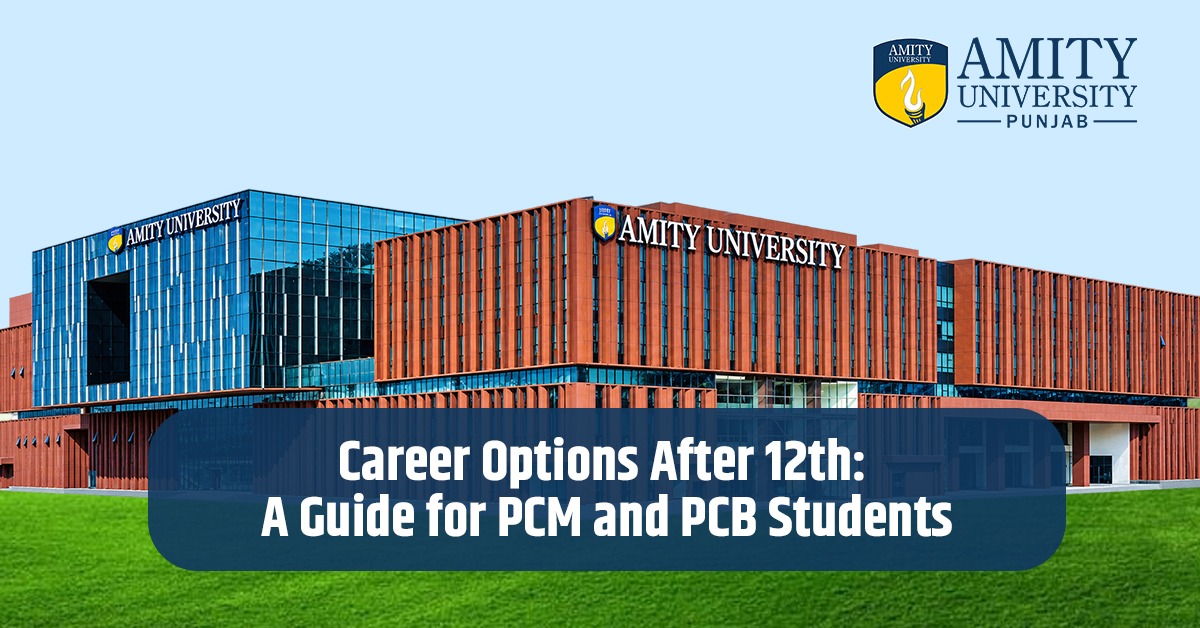
If you've just passed your class 12 exams and are sitting with a result sheet in hand, you'll also wonder about what you should do next. Whether you took PCM or PCB, there are a lot of career options ahead, like engineering, medicine, research, etc. But how do you choose the right career option after completing your schooling? The career path you choose will depend on what your interests are and what your vision is for the long run. This guide will help you decide on the right career option after class 12th.
Before jumping into courses, it helps to see the two paths side by side. PCM commonly opens doors into engineering, technology, and data-driven fields, while PCB commonly leans into medicine, biological sciences, and healthcare. There is overlap; some students shift into pure sciences or research regardless of which stream they picked.
|
Parameter |
PCM Path (Engineering & Tech) |
PCB Path (Medical & Life Sciences) |
|
Typical Duration |
3 to 4 years for UG (longer for integrated/dual programmes) |
3 to 5.5 years, depending on the course (MBBS is longer, B.Sc/B.Pharm is shorter) |
|
Core Subjects |
Maths-heavy: coding, mechanics, electronics, data structures |
Biology-heavy: anatomy, physiology, biochemistry, microbiology |
|
Career Scope |
Software, core engineering, data science, product design, research |
Clinical practice, pharma, biotech, healthcare management, research |
|
Skills Built |
Logical reasoning, problem solving, and technical tools |
Observation, lab work, patient handling (for clinical roles), analysis |
|
Higher Studies |
M.Tech, MBA, MS abroad, specialisations like AI/ML or Data Science |
MD/MS (for MBBS grads), M.Sc, PhD, pharma management, public health |
|
Best Suited For |
Students who enjoy building, coding, or working with systems |
Students drawn to biology, healthcare, or laboratory-based research |
Eligibility criteria and admission steps differ quite a bit from one college to another, so treat what follows purely as an example of how it works at Amity University Punjab, Mohali, not a universal standard.
At Amity Mohali, admission into B. Tech programmes generally require a minimum of 60% aggregate in Class 12, with Physics, Chemistry, and Maths as compulsory subjects, along with English. Selection happens through JEE Main scores or through the university's own entrance test, Amity JEE. Direct admission routes are also opened for students who score 80% and above in their board exams. The course itself runs across four years, split into eight semesters, and specialisations include Computer Science Engineering, AI & Machine Learning, Data Science, Cyber Security, and Biotechnology, among others.
Note: These figures are as per Amity Mohali's own published admission criteria at the time of writing. Confirm with the admissions office before applying, since requirements can be revised each year.
Biology students tend to gravitate toward a handful of paths: B.Sc. programs, B.Pharmacy, or something in allied health sciences. Most of these require around 50% aggregate marks in the qualifying exam, and this number can shift a little depending on which specialisation you pick. Merit decides admission in most cases. That means your Class 12 scores matter, and so does your performance in whatever entrance exam the specific course asks for.
Every institute runs this a bit differently, so there's no single universal list. What follows is specific to Amity University Punjab, Mohali, covering both the documents you'll need and how the selection actually plays out there.
Documents required may include:
Class 10th and 12th mark sheets/passing certificates
Transfer certificate and migration certificate from the previous institution
Entrance exam scorecard (JEE Main, CUET or Amity entrance exam, whichever applicable)
Certificate of Category, if applying in the reserved category
Photographs of passport size and proof of identification
Medical fitness certificate in certain professional courses
At Amity Mohali, the selection process is generally this:
Application form submission
Merit/entrance exam evaluation
Personal interview/counselling, if applicable
Finally, document verification, along with fee payment, confirms the seat.
The fee structure varies across colleges and specialisations. Here at Amity University Mohali, here is what its fee structure looks like.
The total fee for B.Tech courses at Amity Mohali varies based on the course and the specialisation you pursue. However, here's the general fee structure for courses:
B.Tech (CSE): Rs. 2,70,000 (First Year)
B.Tech (CSE) (AI & ML): Rs. 2,35,000 (First Year)
B.Tech (CSE) (Data Science): Rs. 2,35,000 (First Year)
B.Tech (CSE) (Cyber Security): Rs. 2,35,000 (First Year)
B.Tech CSE (AI & ML) Integrated: Rs. 2,94,000 (First Year)
B.Tech (Food Sci. Tech and Proc.): Rs. 1,30,000 (First Year)
For B.Sc courses in the PCB stream, the total fee is:
B. Pharm (Bachelor of Pharmacy): Rs. 2,18,000 (First Year)
B.Sc. (Nutrition & Dietetics) (Honours / Research): Rs. 1,14,000 (First Year)
B.Sc. (Clinical Psychology): Rs. 1,42,000 (First Year)
B.Sc. (Clinical Psychology) (Honours / Research): Rs. 1,42,000 (First Year)
It's easy to think of a degree as just subjects on a mark sheet, but the real value often lies elsewhere.
Students pick up programming across several languages, not just one.
Solve problems in a structured way, often with limited time and limited resources
Working familiarity with the tools that field actually uses.
Project work done in teams, set up in a way like an actual workplace looks like.
Laboratory techniques and precision in experimental work
Understanding of biological systems at a molecular and clinical level
Research methodology, including data interpretation and report writing
Patient interaction and clinical reasoning, in courses that involve direct healthcare exposure
PCM graduates commonly move into software development, core engineering roles in manufacturing or infrastructure, data analytics, product management, and AI-focused positions. Government sector opportunities exist through PSUs and technical services.
PCB graduates, depending on the specific degree, find themselves in clinical practice, pharmaceutical research and quality control, biotechnology labs, healthcare administration, or academic research. Some also pivot into science communication, regulatory affairs, or public health, roles that did not even exist as clearly defined career tracks a decade back.
For engineering graduates entering the software or IT sector, fresher salaries at service-based companies typically land between Rs 3.5 to 8 LPA, while product-based companies and startups can offer anywhere from Rs 6 to 15 LPA for the same experience level, based on data compiled by Recrew's 2026 salary guide. Specialised roles, such as AI or cloud engineering, tend to start higher still, sometimes crossing Rs 8 LPA at the entry level itself, per Cambridge Infotech's industry report.
For the biotech and pharma side, entry-level pay tends to be a bit more modest by comparison. Biotechnology freshers typically start somewhere around ₹3.6 to ₹4 LPA, with the wider range for research, quality, and process roles in biotechnology running from roughly ₹5.7 to ₹20 LPA depending on specialisation. B.Pharm graduates in core pharmacist roles average in a similar band, roughly ₹3.2 to ₹3.6 LPA to start, going up with experience and role.
Note: These are indicative ranges rather than guarantees, and the sector itself is expanding fast. Hence, there will be more entry-level positions over time in research, quality assurance, and production roles within pharmaceutical companies.
India's IT industry is expanding. Nasscom's Annual Strategic Review 2026 places total technology sector revenue for FY26 at an estimated $315 billion, a 6.1% year-on-year rise, pushing India's IT industry firmly past the $300 billion mark. The demand in this industry is changing too, where there has been an increasing focus on specialised skills like AI, cloud computing and cybersecurity, and those roles pay much better starting salaries compared to the regular software roles.
By 2025, India's biotechnology sector had climbed to nearly $37.1 billion, and IBEF's report puts its projected growth at roughly 13% CAGR through 2034. The pharmaceutical side isn't far behind. Market size touched close to Rs 5.2 lakh crore in 2026, per IBEF data on the industry. Exports alone crossed $30 billion in FY25. And here's a number worth sitting with: this one sector accounts for close to 20% of all generic medicines supplied worldwide.
For PCM students, the natural next step after B.Tech is often M.Tech, an MBA for those inclined toward management, or a master's degree abroad in specialised technical fields. Certifications in niche technical areas, cloud platforms, AI frameworks, and cybersecurity also add substantial weight to a resume without requiring a full second degree.
For PCB students, the path depends heavily on the undergraduate course. MBBS graduates move toward MD or MS specialisations. B.Sc graduates often pursue an M.Sc, followed by a PhD if research is the goal. B.Pharm students frequently go on to M.Pharm or step into pharmaceutical management programmes. It's worth remembering here that a bachelor's degree alone rarely qualifies someone for senior clinical or research roles.
Labs built for real industry work: Amity Mohali doesn't stop at biotechnology. There's exposure across artificial intelligence, robotics, and computer science, with facilities designed so students actually get their hands on the work instead of sitting through lecture after lecture.
Placements: The university runs a dedicated wing for this called the Career Resource Centre. Over the years, it's pulled in over 500 companies for campus recruitment, names like Amazon, Accenture, Deloitte, and Airtel among them.
Practically experienced professors: Many professors from this university come with practical or industrial experience along with their academic credentials.
Scholarships: Tuition fee waiver schemes are available for those who have scored above 95% or have scored in the top percentiles in the JEE Main board exams.
Specialisations: From artificial intelligence and machine learning to biotechnology to cyber security, students have the freedom to choose their unique specialisations from the beginning.
Choosing a career path immediately after class 12th doesn't really come across as being final, nor should it be. The important thing is to join a college and take up a program that actually encourages what you want to pursue - PCM or PCB.
If you want to pursue your higher studies in the best universities in Punjab, then choose Amity University Mohali. Get in touch with our admission department and enroll in a program now!
1. Which is better after 12th, PCM or PCB, in terms of career opportunities?
Neither stream is better. While PCM leads more towards the world of engineering and technologies, PCB tends to give more medical-related job options. The choice will depend only on the person's interests and skills, not on the stream being objectively better.
2. Can a PCB student change his field of education to engineering?
Mathematics is a required eligibility subject for B.Tech programmes, and most PCB students haven't studied it at the Class 12 level. In practice, this usually means bridging the Maths requirement separately (through an additional qualifying exam or a specific allowance the university may offer) rather than switching over directly. It's best to check the exact requirement with the admissions office for the programme in question.
3. How much does studying at Amity University Mohali cost for the B.Tech course?
It varies by specialisation and by annual fee revisions. First-year fees for B.Tech programmes at Amity Mohali currently range from about Rs 1.3 lakh to Rs 2.94 lakh depending on the programme. Going by available fee data, the four-year total broadly falls in the Rs 5.2 lakh to Rs 11.8 lakh range, though this should be treated as indicative and confirmed directly with the admissions office at the time of applying.
4. Do I need any coding experience to join a B.Tech course?
There is no need for that. But, in most cases, knowing something about coding in advance will help you with the first year of studies.
5. Is a B.Sc degree sufficient to get a decent job in the biotechnology sector?
It gives you the opportunity to get an entry-level position. For getting other positions or doing research work, an M.Sc degree is necessary.