Top Private Universities in Punjab: Best Higher Education Institutions
2026-04-25

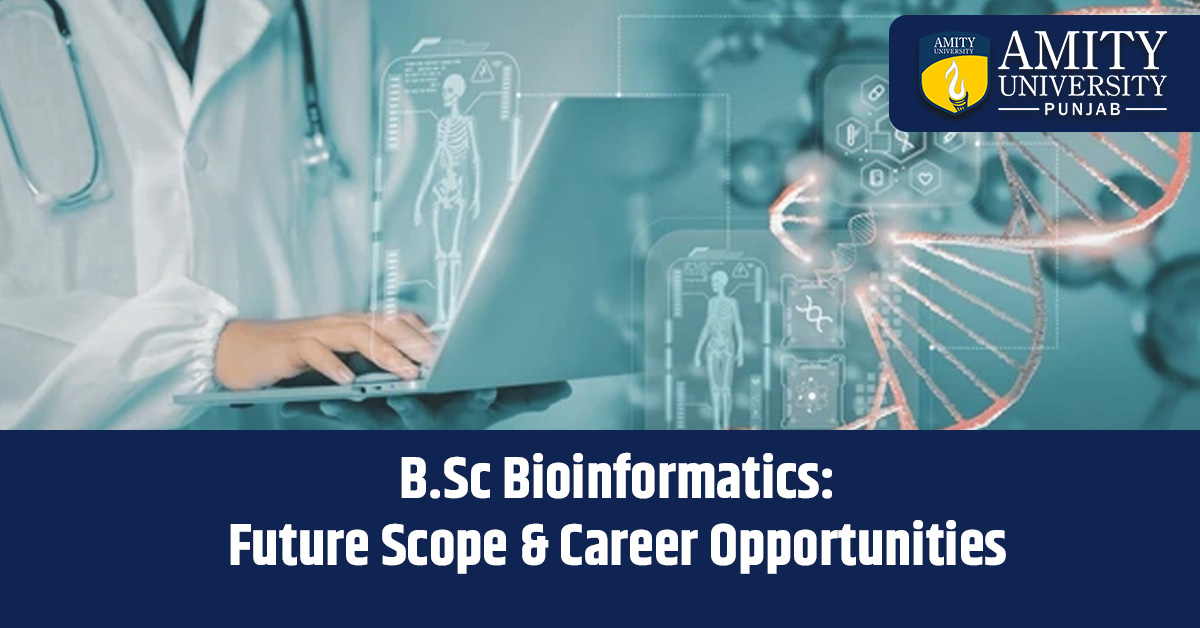
Many students who take science in Class 11 and 12 mostly think about careers like MBBS, Biotechnology, Pharmacy or Microbiology. But now some new fields are also coming, which mix biology with technology. One such field is Bioinformatics. This field is getting popular because today research not only happens in a lab, but also happens through computers and data analysis.
Students who like both biology and technology often feel confused about which course they should select. Some students enjoy the biology subject but also have an interest in computers. For such students, B.Sc Bioinformatics can be a good option. This course helps students understand biological data with the help of computer tools, so it becomes a little different from normal life science courses.
The bioinformatics course scope is increasing because many industries now depend on data-based research in healthcare, medicine, genetics and drug development. Many discoveries today happen through data analysis and not only through lab experiments. Because of this reason, many students are searching for a B.Sc. Bioinformatics colleges in Punjab and other cities, so they can understand future career options better.
In this blog, we will understand course structure, career scope, salary expectations, higher study options and also see how this field compares with biotechnology.
B.Sc Bioinformatics is a course where biology meets computer science and mathematics. In this field, scientists use computers to study DNA, genes, proteins and diseases. They do not depend only on lab experiments. They also use software tools to check and analyse biological data.
The Department of Bioinformatics mainly works on creating computer-based methods that help people understand biological systems better. Researchers use these methods to improve medical research and find solutions for many health problems.
Students who choose B.Sc. Bioinformatics involves learning how to handle complex biological data using programming and statistics. They use tools and software to study patterns inside genes and cells. Because of this reason, many students who like research fields choose this course.
Bioinformatics helps scientists find disease patterns, create new medicines and understand genetic problems. The need for bioinformatics experts keeps increasing because the healthcare industry keeps growing and changing.
Healthcare and biotechnology industries are growing very fast due to new diseases, advanced medicines and personalised treatments. Bioinformatics helps researchers handle very large biological data quickly and more efficiently.
For example, genome sequencing creates a huge amount of data. Researchers must analyse this data with computer tools. Without bioinformatics, scientists may take many years to understand such complex information.
The bioinformatics course scope keeps increasing because industries want professionals who understand both biology and data analysis. Pharmaceutical companies, research labs and healthcare organisations need experts who can understand biological data properly.
Students who like research, healthcare innovation and technology usually see this field as a modern career option with good future scope.
Students who want to study B.Sc. Bioinformatics applicants should know about the duration and eligibility before applying for admission.
B.Sc (Hons) Bioinformatics normally takes 3 years to complete. Some universities also provide a 4-year Honours with Research option for students who want deeper research exposure.
Some institutes also provide integrated courses which combine undergraduate and postgraduate degrees.
Students usually need at least 60% marks in Class 12 with science subjects like Physics, Chemistry, Biology or Mathematics.
Students who show interest in biology and basic computer knowledge usually find this course easier to understand. The curriculum follows NEP 2020 guidelines, so students can continue higher studies in India or even abroad.
Many students want to know which subjects they will study in this course. The curriculum mixes biology subjects with programming and data analysis topics. Students learn how biological data is produced and how computer tools help analyse that data.
Here are the core subjects in Bioinformatics:
Students learn about genes, DNA structure and molecular activities inside cells. Genetics helps students understand how traits pass from one generation to another.
This subject helps students build a strong career in genomics and biomedical research because many diseases are connected with genetic changes.
Biochemistry explains chemical reactions happening inside the human body. Students learn how proteins and enzymes work in different biological processes.
Knowledge of biochemistry helps students understand disease development and the process of creating medicine.
Students learn programming languages like Python, R and C++. Programming helps students analyse large biological datasets faster.
Programming skills play a very important role because bioinformatics depends strongly on computational tools.
Students study genomics, proteomics and transcriptomics under omics studies. These subjects help students understand biological systems at the molecular level in a better way. Students learn how genes, proteins and RNA work together inside living organisms. Researchers use omics studies a lot in drug discovery and also in personalised treatment methods because they give a deeper biological understanding.
Students learn how different software tools help scientists design new medicines and also study chemical structures in detail. Molecular modelling helps researchers predict how molecules behave and interact with each other. Drug design shows one very important use of bioinformatics in the pharmaceutical industry because companies use this method to create better and more effective medicines.
Artificial intelligence helps researchers analyse biological data in a faster and more accurate way. Machine learning methods help scientists find hidden patterns in large genetic datasets, which are not easy to detect manually. AI is becoming more important in biological research because the size of biological data is continuously increasing day by day, and researchers need smart tools to manage it.
Students usually compare biotech vs bioinformatics before selecting the course. Both fields come under life sciences, but both follow different ways and approaches.
Biotechnology mostly includes lab experiments and the study of biological processes. Bioinformatics mainly deals with analysing biological data with the help of computer tools and software.
|
Factor |
Biotechnology |
Bioinformatics |
|
Work environment |
Laboratory |
Computer-based research |
|
Focus area |
Biological experiments |
Data analysis |
|
Skills required |
Biology knowledge |
Biology + programming |
|
Industry demand |
Pharmaceutical labs |
Research & data-driven healthcare |
Students who like practical lab work usually go for biotechnology. Students who feel comfortable with computers and data usually prefer bioinformatics.
Personal interest plays a very important role. When students understand what they enjoy more, they choose a better career path and feel more confident about their future.
Students who complete B.Sc Bioinformatics gains a mix of technical and analytical skills. These skills help them work in the research field and technology-based industries. The course prepares students for real-world scientific problems.
Students learn programming languages that help them analyse biological datasets properly. Knowledge of algorithms helps students handle complex information in an easier way.
Students understand biological data, and they learn how to read genetic information correctly. They also learn different software tools that researchers use in labs and research organisations.
Students improve computer handling skills and become comfortable with databases, sequence analysis tools and bioinformatics platforms.
Students learn how to interpret scientific results, and they identify useful patterns from biological data. Research assignments improve problem-solving ability step by step.
Students develop critical thinking, which helps them in scientific research and innovation. They understand how to connect biology concepts with computational methods.
Students exploring bioinformatics jobs Punjab often want to know whether there are opportunities locally. Bioinformatics professionals are employed in pharmaceutical companies, healthcare research labs, and biotechnology organisations.
Common job roles include:
Bioinformatics Analyst
Computational Biologist
Genomics Researcher
Research Associate
Biostatistician
Software Programmer
These professionals work on analysing biological datasets and supporting research projects.
Industries such as healthcare, agriculture biotechnology, pharmaceutical companies, and research organisations employ bioinformatics graduates.
The bioinformatics salary is considered strong for a specialised science and technology field. Entry-level professionals such as Bioinformatics Analysts or Research Associates can expect starting salaries of around ₹10 lakhs per annum or more, depending on their programming skills, research exposure, and knowledge of genomics tools.
Students usually compare course fees before choosing a college. Understanding fees helps students plan education expenses properly.
Approximate first-year fee structure:
|
Course |
First Year Fees |
|
B.Sc Bioinformatics |
₹1,30,000 |
|
B.Sc Bioinformatics Honours with Research |
₹1,30,000 |
Below are some important reasons why students consider Amity Mohali while evaluating the bioinformatics course scope.
One strong advantage of studying B.Sc. Bioinformatics at Amity Mohali is the interdisciplinary curriculum. Students do not study biology in isolation. Instead, they learn how biological problems are solved using computational tools and programming languages.
Subjects such as genetics, molecular biology, and biochemistry are combined with Linux-based programming, data analysis, and modelling techniques. This helps students understand how biological data is processed and interpreted in real-world research environments.
Because bioinformatics requires both biological understanding and technical skills, learning both areas together helps students build a stronger academic foundation.
The curriculum focuses on areas such as genomics, proteomics, systems biology, and biological data modelling, which are widely used in research and pharmaceutical industries.
Bioinformatics is growing very fast now because today, biological research does not work alone; it also depends on AI and data science tools. Amity Mohali make students learn about AI and machine learning in bioinformatics, so they slowly understand how technology is helping in improving biological research work.
Students also study how machine learning helps in finding patterns inside genetic datasets and is also useful in the personalised medicine area. This type of exposure makes students more updated with the latest research trends going on in the bioinformatics field.
When students understand artificial intelligence use in biology, it gives them an extra benefit when they plan their future in research or technology-based careers. Learning these tools from an early stage makes students more comfortable when they handle complex datasets, which usually look confusing at first.
The curriculum is made according to NEP 2020 guidelines, which mainly focus on flexibility, research knowledge, and skill improvement. Because of this, students get knowledge that is not only useful in India but also helpful at a global level.
Students who want to go abroad for higher studies also get an advantage because the curriculum structure is similar to international academic standards. The program also matches global education needs, so students do not face many problems while applying for postgraduate courses in foreign universities.
When the curriculum is globally relevant, students adjust easily in different academic environments and research cultures without much difficulty.
Amity Mohali focus on helping students build skills that industries actually need in the present time.
Students learn programming languages, data understanding methods, and biological modelling tools that are commonly used in the research field. These skills help students know how biological data helps in making medicines and healthcare solutions better.
When students learn industry-related skills, they can explore bioinformatics jobs in Punjab and also check opportunities in research organisations in India and outside India. After completing a degree, graduates can work in pharma companies, biotechnology firms, healthcare analytics companies, and academic research institutes.
Bioinformatics is not only one subject; it needs knowledge from biology, statistics, and computer science also. At Amity Mohali, faculty members come from different academic backgrounds, so students get an idea about many sides of the subject, not only one part.
Faculty members are not only teaching in the classroom, but they are also involved in research work and collaborative academic projects. Because of this, students learn both theoretical concepts and practical understanding, which is important in the bioinformatics field.
When students learn from interdisciplinary faculty, they slowly understand how different subjects are connected with each other. It helps them see the bigger picture instead of studying topics separately.
This also improves conceptual clarity and makes students feel more confident when solving research-related problems, which sometimes look difficult at first.
Faculty expertise is very important in subjects like bioinformatics because it mixes many fields together, and proper guidance helps students adjust better to interdisciplinary learning.
The bioinformatics course scope is increasing as healthcare and biotechnology industries adopt data-driven research methods.
Students completing a B.Sc Bioinformatics develop skills that combine biology knowledge with computational expertise.
Moreover, there are plenty of career opportunities in pharmaceutical companies, research organisations, and healthcare industries. Students interested in research-based careers often explore this field.
If you’re looking for the best college for B.Sc Bioinformatics in Punjab, then enroll at Amity University Mohali now!
Bioinformatics offers career opportunities in healthcare research, genomics, biotechnology, and the pharmaceutical industries.
Yes, research labs, biotech companies, and healthcare organisations offer opportunities in this field.
Biotechnology focuses on laboratory research, while bioinformatics focuses on computational analysis of biological data.
Salary depends on skills, experience, and industry demand.
Students should evaluate curriculum structure, research exposure, and interdisciplinary learning approach.